

Have you ever seen “ide” pop up in a chat and wondered if it was a typo? You are not alone. The IDE meaning in text slang is simple. It stands for “I don’t even.” People type it when something leaves them speechless, shocked, annoyed, or amazed. It is a short way to say, “I have no words for this.”
Think of it as a sentence that trails off on purpose. The writer cannot finish the thought, so they stop. You will see it in texts, DMs, and comments. This guide explains what it means, how people use it, how to reply, and where it can go wrong. No slang background needed. Short examples are included along the way.
IDE Meaning in Text Slang – Quick Meaning
IDE means “I don’t even.” It is a texting abbreviation for being at a loss for words. People use it when they feel shocked, frustrated, or overwhelmed. It can also show disbelief or joy. The message is the same each time. The person is too stunned to finish the sentence. It is casual slang. It fits chats with friends. It does not fit formal messages.
Simple Examples
- “He left me on read for three days and then said ‘hey.’ ide”
- “Look at this cake. Ide, it is too pretty to eat.”
- “My phone died right before the sale ended. ide.”
- “She said yes!! ide I am so happy.”
Notice the pattern. The feeling changes, but the “no words left” idea stays.
How to Respond When Someone Uses IDE
Your reply depends on the mood. First, read the message around it. Is the person upset or just excited? Then pick a reply that matches.
Casual Replies
Keep it light and quick.
- “Wait, what happened?”
- “Okay, tell me everything.”
- “Same, honestly.”
Funny Replies
Humor works when the news is small or silly.
- “Take a breath. Then take a snack.”
- “Did you just run out of words? That is a first.”
- “Add it to the list of things we cannot explain.”
Mature or Supportive Replies
Sometimes IDE hides real stress. A kind reply helps.
- “That sounds like a lot. Want to talk about it?”
- “I’m here if you need to vent.”
- “Take your time. I’m listening.”
Private or Respectful Replies
Some topics feel too big for a group chat. Move the talk to a safer space.
- “Can I call you later?”
- “Let’s chat in private.”
- “No pressure. Tell me when you’re ready.”
Origin & Background of IDE in Slang
Here is the honest answer. No one has found a clear first use of IDE. There is no famous post or person tied to it. So this guide will not make one up.
What we can say is simple. “I don’t even” is a spoken phrase. People say it out loud when they cannot find the words. Texters then shortened it to the first letters, the same way they shortened many other phrases. The longer slang “IDEK” means “I don’t even know,” and dictionaries list it as internet and text-message slang. IDE appears to follow the same pattern.
IDE is also less common than its cousins. You will see IDK and IDEK far more often. Many people type the full phrase instead.
Why Abbreviations Became Popular
Early mobile phones made typing slow. Messages had limits on length. Short forms saved time and effort.
Speed was only part of the story. Short forms also feel friendly. They sound like how people talk to close friends. Over time, apps like Instagram, TikTok, and WhatsApp made this style even more common.
Abbreviations also show emotion fast. A few letters can say what a long sentence might not.
Real-Life Conversations Using IDE
Here are four sample chats. They show how the slang sounds in real life.
WhatsApp Chat
Maya: Did you see the group photo?
Zoe: Yes. Why am I blinking in every shot?
Maya: Ide 😂
Zoe: Next time we take fifty.
Instagram DM Conversation
Sam: Look at this reel. He parked a truck in a tiny spot.
Leo: Ide. How did he even fit?
Sam: Pure skill.
Leo: Or pure luck.
TikTok Comment Section
- “She stuck the landing on one foot. ide”
- “Ide, the cat just opened the fridge.”
- “Same. Ide.”
Comments stay short. The slang fits that style well.
Text Message Example
Dan: The store charged me twice.
Ana: Ide. Did you call them?
Dan: Yes. I’m on hold now.
Ana: Send me updates. I’ll bring snacks later.
Read More: IHY Meaning in Text: What Does IHY Really Mean?
Common Misunderstandings About IDE
A few mix-ups come up often. Let’s clear them up.
Thinking IDE Is a Typo
Many people read “ide” and think someone missed a key. That is a fair guess. The tip-off is the setting. If the message shows strong feeling and no clear word, it is probably slang.
If you are unsure, ask. A quick “Do you mean ‘I don’t even’?” solves it.
Confusing IDE With Technical Terms
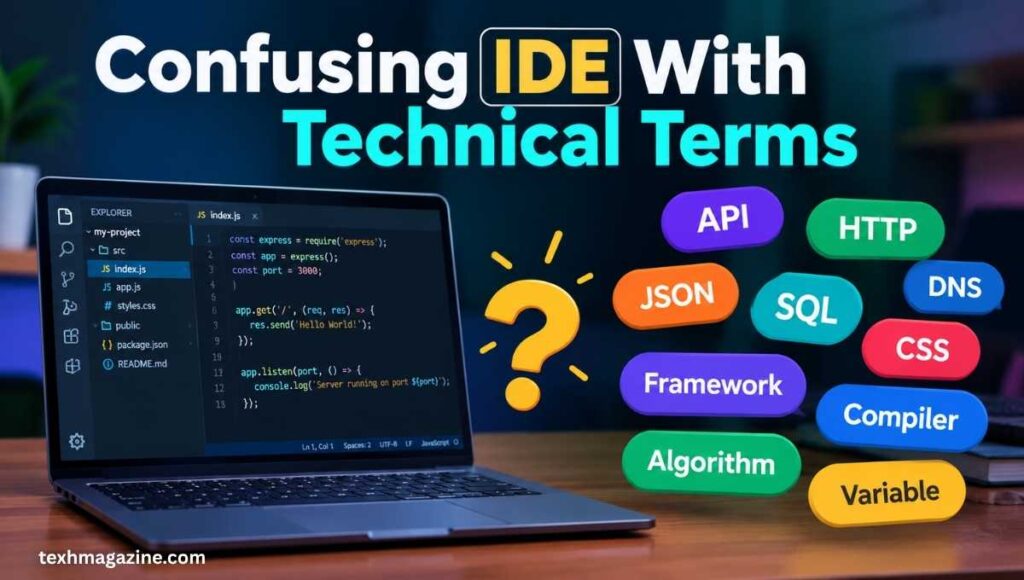
In tech, IDE also stands for “integrated development environment.” That is a program coders use to write software. It has nothing to do with slang.
Context tells you which one is meant. In a chat about feelings or memes, think “I don’t even.” In a chat about coding tools, think software.
Using IDE Too Formally
Slang works best in relaxed talk. A work email that says “ide” can confuse the reader. It may also look careless. Save it for friends and casual chats.
IDE vs. Other Texting Abbreviations
Texting slang is full of short forms. Some sound alike, but each has its own job. Here is how IDE compares with a few popular ones.
Comparison of IDE, IDK, SMH, OMG, and TBH
| Abbreviation | Full Phrase | Main Feeling | Example |
| IDE | I don’t even | Speechless or overwhelmed | “He said that to me? ide” |
| IDK | I don’t know | Not sure | “IDK where we parked.” |
| SMH | Shaking my head | Disappointed | “SMH, he forgot again.” |
| OMG | A shout of surprise | Shock or excitement | “OMG, you won!” |
| TBH | To be honest | Truthful opinion | “TBH, I loved it.” |
IDE and IDK look close, but they differ. IDK says you lack information. IDE says you lack words. IDE and SMH also differ. SMH shows mild disapproval. IDE can show shock, joy, or stress. As for IDE vs OMG, OMG is louder and more general. IDE feels quieter and more personal.
Emotional & Psychological Meaning of IDE
IDE is a small tool for big feelings. When people are overwhelmed, language can feel too slow. A short, broken phrase fits that moment better than a neat paragraph.
It also signals trust. Sending IDE to a friend says, “I do not need to explain. You get me.” That shortcut builds closeness.
Why People Relate to It
Almost everyone has felt stuck for words. Good news, bad news, or plain chaos can all do it. IDE gives that feeling a name.
It also lowers pressure. You do not have to sound smart or calm. You can admit you are overwhelmed and move on.
Variations and Related Expressions
IDE has many relatives. Each one covers a slightly different mood.
IDEK
IDEK means “I don’t even know.” It adds a bit more drama than IDK. Use it when you feel truly lost.
IDTS
IDTS means “I don’t think so.” It is a polite, light “no.” It is also a bit playful.
SMH
SMH means “shaking my head.” It shows mild disappointment. People use it when someone does something silly.
ICYMI
ICYMI means “in case you missed it.” People use it to share news again. It often starts a post.
TBH
TBH means “to be honest.” It comes before an open opinion. It can feel kind or blunt, depending on the rest.
FWIW
FWIW means “for what it’s worth.” It softens advice. It says, “Take it or leave it.”
IDK
IDK means “I don’t know.” It is one of the most used short forms in texting. Tone changes its meaning. A flat “idk” can sound bored.
IDC
IDC means “I don’t care.” It can sound cold. Use it with care.
IYKYK
IYKYK means “if you know, you know.” It points to an inside joke. Only the right people will get it.
SMFH
SMFH is a stronger, ruder version of SMH. It shows deeper annoyance. Many people skip it in polite chats.
Usage of IDE in Different Contexts
The same letters can feel different in different places. Think about who is reading.
Social Media
On social media, IDE shows up in captions, reaction posts, and memes. It works well under funny or shocking clips. Gaming communities and online forums use it too. A player may type it after a wild match.
Friends & Relationships
Among friends, IDE feels natural. It can mean, “That is unbelievable.” In close relationships, it may also mean, “I am hurt and need a minute.” If the tone seems heavy, check in.
Work or Professional Settings
Avoid IDE in professional communication. Coworkers may not know it. Clients may read it as rude. Write the full sentence instead. If a team chat is very casual, follow the group’s style.
Casual vs. Serious Tone
A smile or laughing emoji makes IDE feel light. A period alone can make it feel heavy. Compare “ide 😂” with “ide.” The first sounds playful. The second sounds tired or upset.
IDE Meaning Across Different Cultures and Regions

There is no solid research on how IDE differs by country. So this section stays general. What we know is that English slang travels fast online, and people shape it to fit their own talk.
Western Culture
In English-speaking countries, short forms are common in casual texts. Many young adults and teens use them daily. Still, IDE is less common than IDK.
Asian Culture
Many people in Asia text in more than one language. Some mix English slang into their chats. Others use short forms from their own language. English slang may feel playful, or may not be used at all.
Middle Eastern Culture
Chat users in this region also blend languages. Some write Arabic in English letters, and some add English slang. People may know IDE from social media. Others may not. When in doubt, spell it out.
Global Internet Usage
The web is shared by many cultures. A meme from one place can reach another within hours. Still, not everyone knows every slang term. If you chat across borders, keep your words clear.
Is IDE Still Popular in Texting Today?
IDE is still around, but it is a niche term. It lives mostly in casual chats, comments, and captions. Younger internet users spot it more often than older adults do.
Longer forms like “I can’t even” and “I don’t even” also stay popular when people type the whole thing. Slang changes fast, so its future is hard to predict. For now, it is understood in many online spaces, though not everywhere.
When Should You Use IDE and When Should You Avoid It?
Use IDE when:
- You are chatting with friends.
- The mood is casual.
- You feel shocked, amazed, or overwhelmed.
- The other person likely knows slang.
Skip IDE when:
- You write to a boss, teacher, or client.
- The topic is serious or sad.
- The reader may not know the term.
- You need to explain a problem clearly.
A simple rule helps. If you would not say it out loud in that setting, do not type it.
FAQs About IDE in Text Slang
What Does IDE Mean in Texting?
IDE means “I don’t even.” People use it when they feel too shocked, upset, or amazed to finish a thought.
Is IDE the Same as IDK?
No. IDK means “I don’t know.” It shows missing facts. IDE shows missing words. One is about knowledge. The other is about feeling.
Is IDE Rude?
Not by itself. It is mild and common. The tone around it matters. Aimed at a person in a harsh way, it can sound dismissive. Used to share a feeling, it is fine.
Can IDE Be Used in Professional Messages?
It is best to avoid it. Professional notes need clear, complete words. Keep IDE for casual chats with people who know your style.
Why Do People Use IDE Instead of Full Sentences?
It is fast, and it matches the feeling. When someone is overwhelmed, a short fragment feels more honest than a long sentence.
Does IDE Always Mean Frustration?
No. It can also show joy, awe, or disbelief. Look at the emojis, the topic, and the rest of the chat to know the mood.
Conclusion
IDE is a small abbreviation with a big job. It says, “I don’t even,” and shows a moment when words fail. It can mean shock, joy, annoyance, or stress. Context is the key to reading it right.
Use it with friends and in casual spaces. Skip it at work and in serious talks. If you are not sure what someone means, just ask. A short question beats a wrong guess, and you will always know the IDE meaning in text slang the next time it shows up.

Liam Joseph Miller is a content writer and language enthusiast who enjoys making difficult words, phrases, slang, and text meanings easy to understand. He writes clear, practical, and reader-friendly articles for TexhMagazine, helping readers explore everyday language with simple definitions and useful examples.
